ego alter ego
a new project
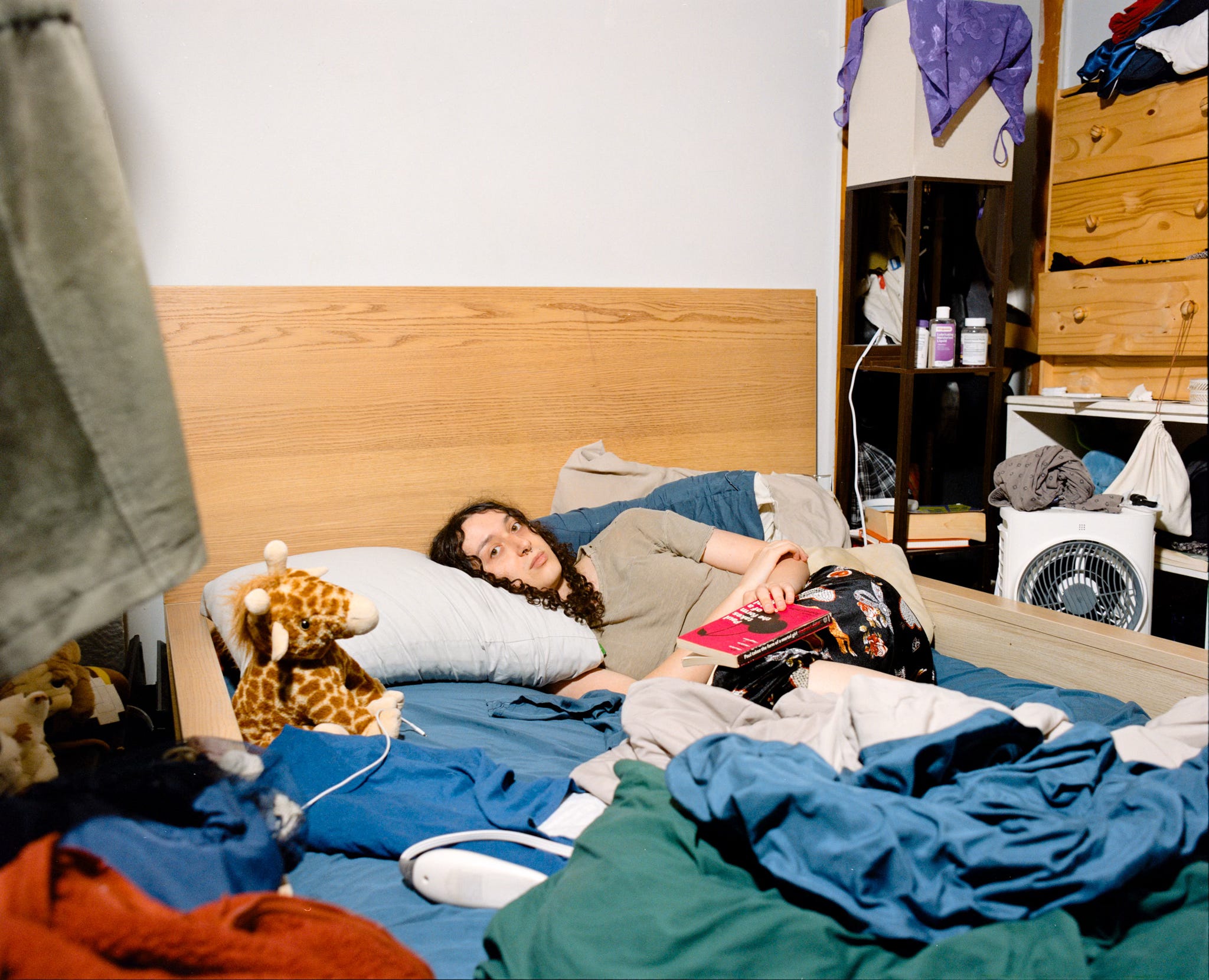
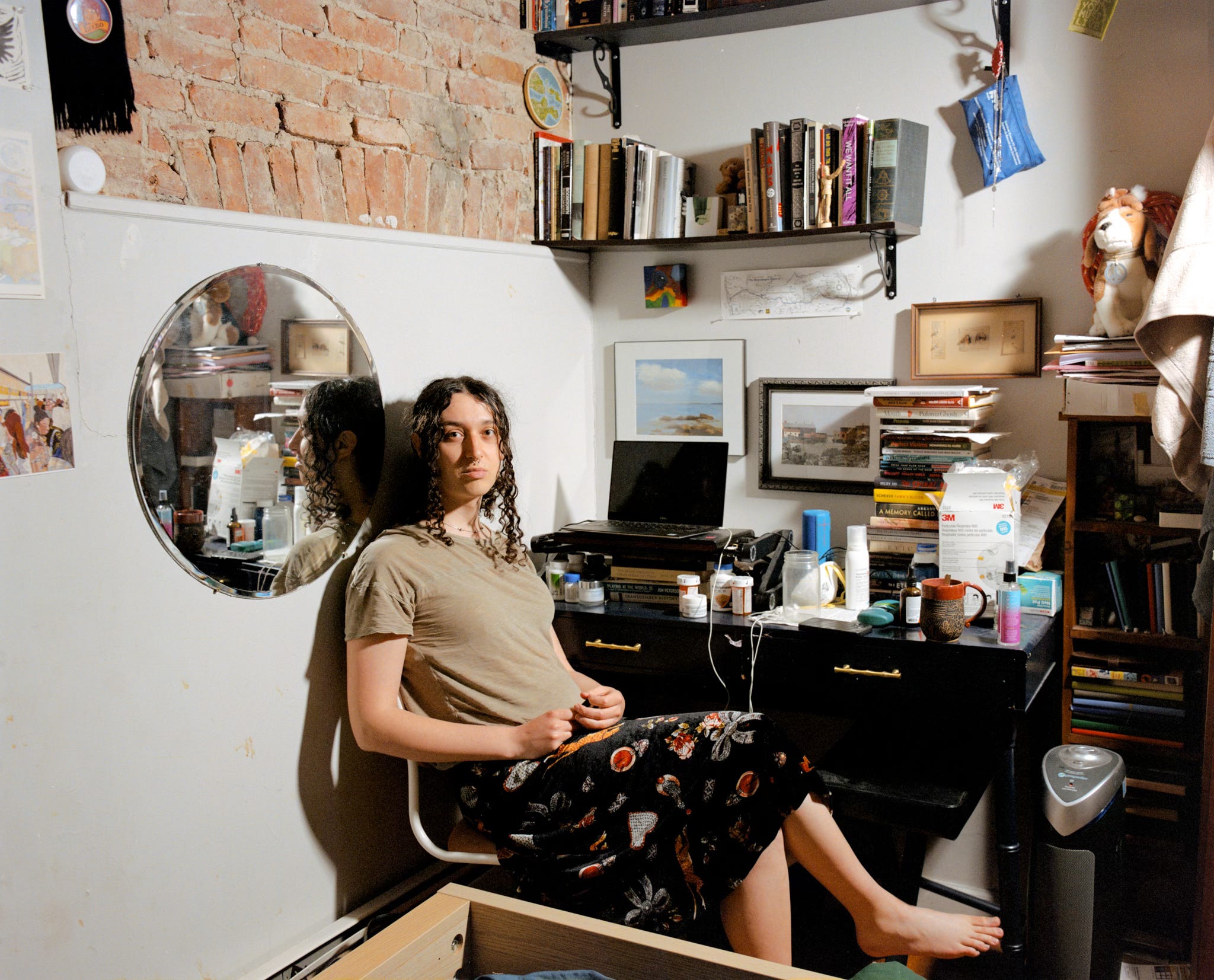
Over the past weekend, part of a collaborative project I’m working on with the photographer Jäger Nachreiner was shown at Gallery 198 in Gowanus, as part of New York’s new Trans Art Fest. Jäger has been taking photographs of trans New Yorkers in their bedrooms, and I’ve been providing “fictional captions” to these images.
In discussing the project in its conception stages, Jäger showed me the work of Adrienne Salinger, who photographed American teenagers in their bedrooms in the 1990s.1 In my reading, Salinger’s photographs achieve their almost miraculous intimacy through an essential humility and generosity. She is willing to let her photographs reveal things that their subjects may not understand about themselves — a certain irony suffuses these pictures — but there’s something about the images that invites us to live inside of these worlds, not merely look in on them. It’s easy for a photograph to discredit, mock, or condescend to its subject, and it takes a special kind of skill and patience to reveal everything without harming it in the process. Jäger’s photographs, which take as their central insight that privacy has a special importance for trans people, have a similar quality of intimacy, warmth, and familiarity that you see in Salinger’s work.2
To accompany work like this with fiction is a real challenge. The photos all seem to already contain a story, or many possible stories that all happen to intersect at the moment of the image. It’s difficult to have anything to add that doesn’t constrain the possible “readings” of the image and thereby reduce its power of suggestion.
Salinger, for her part, conducted lengthy interviews with her subjects, which she captured on video and carefully excerpted from, so that each photograph has a bit of the subject’s voice in it, selected by Salinger in much the same manner as she selected an angle for the camera, a place to sit in the room, a moment to press the shutter. The resulting text is often enigmatic in much the same way the photos are. Part of what creates the effect of the text is its often stark difference from the photographs. The text usually creates distance rather than intimacy, a reminder that you, the viewer, do not really know this person, cannot know them through such a limited view.
I decided that the route I’d go would be to avoid competing with the photographs: there’s nothing I could add to them besides the sense of an outside, and accordingly I had to get as far away from the photos as possible. The form I settled on was a pair of stories that are intended to complement and subtly undermine each other — one in first person, one in third person. Ideally, they’d be placed in two columns next to each other, such that they could conceivably be read contrapuntally.
This is the first entry in the series. The subject of these photographs is the writer Evergreen Ippolito, who has a forthcoming book.3
We’re planning on doing a lot more of these; if you’re interested in being a part of this project you should reach out to Jäger or myself.
A
I mean, you know me, my impulse is always to empathize. It’s not like I never had a few bad days that turned into a few numbed-out weeks. She’s been going through a lot. The whole thing with her car, her brother getting arrested, getting put on a PIP at work. But what I just keep thinking is, like, I don’t want to feel chased out. Does that sound dramatic? I don’t know. I’m just thinking about how badly I wanted to feel at home with her. I can live anywhere as long as I feel at home there. Does that make sense? Home, I know now, it’s like a choice you have to make with other people. There aren’t any good choices, or, like, you’re constrained in those choices. No ethical consumption or whatever. But I’m here. And I’m, like, not a kid anymore, you know? I mean, I’ve been trying to talk to her like an adult about this whole thing, this conflict. But she’s never there. I guess you can’t call it a conflict if someone’s just not there, like, physically. But she’s here, she’s taking up more space than ever actually. Every time I leave a book out in the living room or whatever, she puts it next to my bedroom door. Can you believe that? It’s like I’m back home. Well, not home, just back there. I got chased out at home, so I’m just kinda activated when someone’s de facto giving me the silent treatment. I can take a hint. When she’s here, her door is locked, or if she’s out in the kitchen or living room she’s having some conversation with that boyfriend that I can’t understand at all.
I don’t know. I’m not making sense. I just miss my friend. That’s all. I don’t really need to say much more. I wonder if she’s trying to get some kind of reaction out of me, and it’s like, I’m not going to get angry. I feel bad for her. I’ve seen where silence goes. I used to live inside of silence.
Something I’ve been thinking about lately is that you can go almost anywhere in this city and it’s like they expected you there. You have to go a long way to get somewhere where they’re not expecting you even a little. Let me explain what I mean. You’re outside in this neighborhood, and you get the occasional pair of eyes swiveling your way if you look a little odd. I don’t think I look odd, but everyone else seems to, so I get a little bit of that, and it doesn’t really matter. Back home — I gotta stop saying that, back there — it was worse. I mean, like, whatever, of course it was worse, whatever. That’s the justification people use for moving to places like this and being a gentrifier. It’s better to just own your decisions. I was chased out but it wasn’t just because people were mean to me. There’s girls where I used to live, now.
Let me start over. Sorry. My point is that when you go somewhere, you’re free to be yourself, no one really cares, no one’s gonna be that nasty to you. I mean, maybe they will, but that could happen to everyone. One time I saw a regular guy getting just screamed at on the subway. He looked like I used to look like, which is to say, no one in particular. But anyway, there’s this way that the city recognizes you anyway. There’s stuff for you to do that’s really dependent on the city’s ability to sort you into a group of people, like, the different bars and stuff. But there’s also a sense that you fit into the fabric of a place like this. Like, back where I used to live, back there, it was way easier to fall completely off the map. By that I mean that I’d like, borrow my sister’s car and drive it to the river, by the highway, not really a nice spot, and there was a bench there made out of an old wine barrel and a big bucket where people put their cigarette butts. That’s a place that recognizes you. But you can go a little further and there’s nothing. You’re off the map, just like that.
It’s easier to get off the map figuratively speaking, too. I go outside, and if I make it to like, Broadway, even the crazy people have a place. People seem to know them, expect to see them there. And some of the crazy people are even outside of language, outside of ordinary meaning. That’s about as far outside as you can get, and they’re still on the map.
So, like, these days my choices are my bedroom, where I’m all alone, and outside, where everyone already knows me. We have a backyard but you have to go through her room to get there. So I’m in here. It used to be easier to choose everyone else over myself.
I would have chosen her, maybe. That’s the other way to live, and why we need other people to love us: because they don’t put us on a map. But that’s not gonna work with her. I just wish we could talk about it, like adults. The longer we avoid it, the more I can feel myself settling back into that same old silence.
When I’m outside I see a lot of new trans women. I wonder where they came from. It feels like even a couple years ago, et cetera. I remember, when the two of us moved here this neighborhood wasn’t really a thing. It was on the map but only barely. Now every day I’m like, oh. That’s an example of what I mean, I guess: everyone does this, everyone is the map.
I don’t feel bad for myself. I’m past that. Sometimes I look at those girls and I think about how I’d like to step into their lives. I used to think stuff like that, before. Everyone did I guess. I’m not really special. But I still don’t really have anything going on.
B
The first day she got to his office it was flooded. A basement, and it had rained, but not that much.
Walk with me, he said. The bottom two inches of his khakis were soaked. He was carrying his desktop computer tower in his arms like a baby.
He was way younger than she had expected from the emails. He didn’t talk to her as they made their way down an unfamiliar set of streets in the brilliant sunshine before pausing in front of a building identical to all the others.
This is a six-flat, he said. You probably live in one of these, right?
Yeah, she said.
There are hundreds of thousands of these things. And we’re in charge of about two hundred of them. I only work with this kind of building. You’ll become very familiar with their ways.
Okay, she said again.
That turned out to be a lie. She didn’t learn anything about the ways of any kind of building. She did get pretty familiar with several city websites that were used to upload documentation of various kinds. And she got familiar with her ancient laptop, which had been on the verge of breaking for years. She’d never had to worry about it. He kept saying that he’d find a new office and get her a proper work computer for this stuff, but it never happened.
In the morning, without any specific instructions iMessage her a link to a password-protected website with a bunch of handwritten documents that looked like they had been photographed on a 2005 digital camera, and something like twenty minutes later he’d send her a second iMessage link to a Google Sheet with columns that matched the pixely headings on the documents.
Check if this matches, he’d text. If so upload to city portal.
Her laptop was a serious problem almost immediately. It was an ancient VAIO that had belonged to an aunt back in Medford. When it turned on there was a 50/50 chance it would shut down almost immediately. A conventional web browser with more than two tabs would make the fan go on full blast almost immediately. Software updates — as were required to use the PDF-reading software he had her download later — would wreak havoc on the computer’s ability to do anything at all. On her fourth day on the job, she tried doing the spreadsheets on her phone, and it worked a lot better. Then, an hour later, agitated by the confinement of her room and the whining strain of her air conditioner, she took the phone outside to her stoop. Then, on an impulse, she walked to the end of her block with her phone, typing things into spreadsheets.
She took almost immediately to walking around aimlessly while doing her job on her phone. She’d stop in delis, cafés, the library. Big loops around the spline of Broadway, in and out of Bed-Stuy and Bushwick. Initially, brought the laptop with her as a formality, but quickly abandoned that.
She liked getting home at the same time everyone else did. When it was barely starting to get dark and the light from her windows was a softer shade. And that way her bedroom was only for her, and not the place where she did her job. She moved the books back on to it.
He was late paying her every two weeks. She’d have to send him another iMessage about it and he’d reply, yeah, it’s coming. But one day when a technicality meant that she couldn’t upload something on mobile, she told him that her laptop had died weeks ago. Two days later there was a package with a brand-new MacBook in the lobby of her building. Her roommate brought it up and texted a picture to her with just two question marks, and that message made her too ashamed to open the box for four days, when she ran into the same problem with her phone. Her habits were working for her, she thought, so she kept using her phone, and when she had to use the desktop version of the site she’d make her way to whichever branch of the library was closest to her.
The library during the middle of the day on a weekday is a sad place. She often ran into her unemployed friend there. They’d nod at each other from across one of the big tables.
I’m getting a handle on things, you know, the unemployed friend said one day, making a sort of backhanded gesture toward her laptop screen. Once she looked over her shoulder at the laptop and found a Word document with a list of “things to work on,” sorted into “tangible” and “intangible” columns. The first thing in the “tangible” category was, “the sink again.” The first thing in the “intangible” column was “look at people while they’re talking to you.”
Walking around, she started to notice all the people on their phones, nearly everyone, walking sitting standing waiting, and she wondered if anyone else was doing what she was doing.
When she got home around five or six, the tree next to the kitchen window was casting a gigantic dappled scrim over the nasty tile, the dirty dishes. Above the sink and directly underneath the piss-yellow cabinets there was a bare fluorescent tube with a greasy pullchain on one side of it. One day it buzzed and finally went out, and she realized it was bolted in from both sides, you’d have to take the whole thing out of the wall. She also noticed that there was a whole host of gigantic, dead flies in the back of it, so there had to be some way in. She told herself she’d fix it and never did. By then her and the roommate weren’t speaking, which was part of the reason she liked staying outside.
He still said he was looking for an office by the end of the summer. It’s not the highest priority thing right now, he said, again over iMessage. She started to realize she had the language of city regulations, of lawsuits, of eviction proceedings, of money had seeped in to her like so much plastic trash. As the night fell quicker, she did start to notice the six-flats. Picking them out from streets where they sat amidst other sorts of buildings. Sometimes she’d stand on some anonymous corner and look up at the windows glowing in them like eyes. When you’re in your own bedroom, like her own bedroom, you don’t think of it as a part of an entire building. One exact fraction of it.
Near her house there was an empty space surrounded by a very old-looking fence. She’d often pass it by on her walks. In the back of it there was a very old car. Pristine. Available surfaces for graffiti that sat untouched. The fence was tall and topped with sharp ends. One day in the fall the padlock that secured the gate was undone and the chain was on the ground. She noticed this. The next time she passed it the gate had been pushed open and the chain was gone, but nothing else had changed. A week later, the car was gone, and where it had been (probably a coincidence), there was a scrap of blue tarp, a PVC pipe, a pile of towels and socks, and four empty wine bottles. Then there was another similar pile in the opposite corner of the big space. The oak and plane trees that surrounded the little lot shed their leaves. Graffiti started to appear on the green plastic mesh material that was woven through the rear cyclone fencing, first scrawly and hasty, then large and plush and confident.
One day it had been cleaned out — empty even of leaves — but the gate was left open. The only thing in it was a single, white wooden stool. Broken, of course, one of the legs had a dramatic crack running up its side. She finally went in there, crossing the space she had experienced before as a sort of diorama space, and sat on the stool. She was finally just another part of the picture.
Her book compiling this body of work was recently reissued by D.A.P.
This is a quality shared, in my judgement, by the work of certain other photographers who combine documentary and portraiture work, like Alec Soth and Deanna Dikeman.
This is probably obvious, but to be 100% clear, I did not have any aspects of Evergreen’s biography in mind when I wrote these pieces.